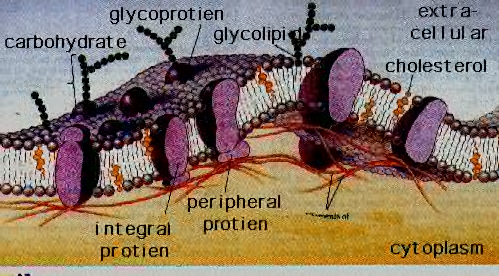
Membrane Structure


The plasma membrane is a lipid bilayer with embedded protein. The membrane controls the permeability of the cell to water and dissolved substances. This is known as the fluid mosaic model of biological membranes (mosaic because it includes proteins, cholesterol, and other types of molecules besides phospholipids).

Constituents

  • Glycoproteins
    Glyco-proteins are processed in the Endoplasmic reticulum, and a carbohydrate chain is added on.
  • Glycolipids (lipids with carbohydrates attached to them)
  • Integral proteins (easily removed)
  • Peripheral proteins (removed only when the whole membrane is broken)
  • Cholesterol
    Notice that there are molecules of cholesterol embedded in the membrane. Cholesterol is a necessary component of biological membranes. Cholesterol breaks up the Van der Waals interactions and close packing of the phospholipid tails. This disruption makes the membrane more fluid. Therefore, one way for a cell to control the fluidity of its membrane is by regulating its level of cholesterol in the cell membrane.
  • Phospholipids (diagram)
    Another way for the cell to control the fluidity of its membrane is to regulate the ratio of saturated to unsaturated hydrocarbon chains of the phospholipids. Saturated hydrocarbons are straight-chains ("saturated" with hydrogens), and unsaturated hydrocarbons have one or more double bonds (not "saturated" with hydrogens). A group of phospholipids with saturated hydrocarbon chains can pack close together and form numerous Van der Waals bonds that hold the phospholipids to each other. Phospholipids with unsaturated hydrocarbon side chains break up those Van der Waals bonds and the tight packing by preventing the phospholipids from getting close together
  • Function of plasma membrane proteins
  • Transport Channel
  • Enzyme
  • Receptor site
  • Cell identity marker
  • Cell adhesion
  • Attachment of cytoskeleton

  • Back to home page

    Back to Cellular Movement page