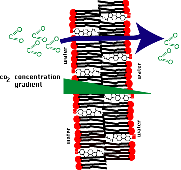
Diffusion
Process by which a substance moves from a region of higher concentration of that substance to a region of lower concentration of that substance. The rate of diffusion will vary depending on the its: size, polarity, charge and concentration on the inside of the membrane versus the concentration on the outside of the membrane. When something is permeable it means that something can spread throughout.Back to page contents

Facilitated Diffusion
Back to page contents
Osmosis
Various substances will pass through the membranes at varying rates through osmosis. Here is a list of some molecules that pass through the membrane without assistance, in other words, through osmosis:
|
|
|
|
|
Back to page contents
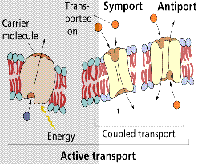
Active Transport
Active transport requires the expenditure of energy to transport the molecule from one side of the membrane to the other, but active transport is the only type of transport that can actually take molecules up their concentration gradient as well as down. Similarly to facilitated transport, active transport is limited by the number of protein transporters present.Back to page contents
Phagocytosis
Phagocytosis is the process by which the cell can obtain particles which are too large to be absorbed by diffusion or active transport - "cell feeding".Back to page contents

Pinocytosis
Pinocytosis is similar to phagocytosis except that the vesicles produced are smaller - "cell drinking".Back to page contents

Sodium Potassium Pump
Back to page contents