| Monsaccharides | Disaccharides | Polysaccharides |
|---|---|---|
 |
 |
|
sweet in taste soluble crystalline | not sweet non-soluble amorphous (not crystalline) | |
glucose fructose lactose | sucrose (fructose+glucose) maltose (glucose+glucose) lactose (galactose+glucose) | starch glycogen cellulose |
Starches
ROLE OF LIPIDS
FATS
Building up of Fats
Unsaturated Fats
Saturated Fats
PHOSPHOLIPIDS
Role
STEROIDS
Structurally they differ from each other in:
General Structure:
In cholesterol, the branched hydrocarbon chain is attached to C-17.
Example of steroids
AMINO ACIDS
Amino Acids are amphoteric substances
Classes of amino acids:
STRUCTURE OF PROTEINS
CLASSIFICATION OF PROTEINS
Based on their composition
GENERAL CHARACTERISTICS OF PROTEINS
[Link to website on protein sequencing]
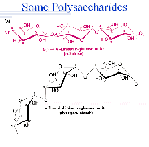
Polysacccharides formed from glucose
Simplest structure: amylose Click here for picture
Amylopectin is a complicated variant of amylose (plant starch)
PECTINS: branched polysaccharides
1) Glycogen: highly branched animal starch
2) Cellulose: plant starch with alternating glucose subunit orientations
** Starch degrading enzyme cannot break the bond between two sugars in opposite orientation. Therefore cellulose cannot readily be broken down -- good structural material.
CHITIN: modified form of cellulose in which a N-group has been added to glucose units (i.e. crab shells)
Lipids
- excess carbohydrates are converted into fat
- beneath skin, around organs
- sub-cutaneous fat
Fats
Phospholipids
Steroids
Glycerol + 3 fatty acids

Glycerol + 2 fatty acids

- simple lipids containing C, H and O
- made up of glycerol and fatty acids
Trihydex alcohol (3 hydroxyl groups)
- long/short chains of hydrocarbons (C/H)
- carboxyl group at one end
- fatty acids used may be the same or different, unsaturated or saturated
a) Saturated fatty acids [Click here]
b) Unsaturated fatty acids [Click here]
Hydroxyl groups of glycerol interact with carboxyl groups of fatty acids
- water is eliminated
- ester bond results from the reaction between acid and alcohol
- fat formed depends on fatty acid used
[Click here for diagram illustrating building up of fats]
Formed from unsaturated fatty acids (has double bonds)
Lower melting points than saturated fats
Most are liquid at room temperature (oils)
Plants fats: cottoseed oil, peanut oil, sesame seed oil, olive oil
Formed from saturated fatty acids (ONLY single bonds)
More calories because it is richer in energy
Diet of saturated fats (red meat, lamb, lard) can lead to diseases of heart & major arteries
Animal fats: palmitic acid, stearic acid
- Complex lipids
- Amphiphilic lipids
- Glycerol + 2 fatty acids + PO
Polar group is substituted for one of the three fatty acids in a fat molecule.
--> many cases, includes a phosphate group (PO
--> most cases, the PO
- Most abundant phospholipid: phosphatidyl ethanolamine (cophalin)
*major constituent of cell membranes*
- Structural
- Transport of fat in the blood (since phospholipids are soluble in water)
- Some are a source of choline
 Have certain properties like lipids.
-- insoluble in water, soluble in organic solvents
a) location and nature of side group
b) location of certain double bonds
* skeleton of 4 rings (17 C-atoms)
OH attached to C-3
CH
[Back to page contents]
Proteins
FUNCTION OF PROTEINS
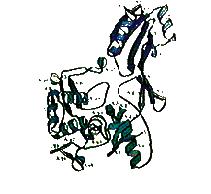

Fundamental structural unit of proteins
White, crystalline, soluble in water
Optically active except glycine
Optical isomers or stereoisomers
--> linkage of atoms are the same, differ only in the way that the constituent atoms are arranged in space
--> caused by presence of asymmetric C
Non-polar R groups (hydrophobic a.a.)
Polar R groups (hydrophillic a.a.)
Positively charged R group (NH
Negatively charged R group (COO-)
Non-essential amino acids
Remaining 10 cannot be synthesized and must be taken in diet. e.g. alanine, serine, lysine, aspartic acid
Insulin was the first protein to have its sequence determined by Frederick Sanger.
Primary Structure
The sequence of amino acids in a protein together with the location of disulfide bridges.
Single polypeptide chain.
Secondary Structure
Polypeptide chains are not in the extended form but folded into sheets (fibrous) or wrapped into coils (globular).
In many cases, folded into long spiral or helix maintained by S-S bridges and H-bonds between adjacent O-H atoms.
Tertiary Structure
Quaternary Structure
Aggregate of subunits (eg. haemoglobin)
Weak H-bonds keep the 4 polypeptide chains together.
Based on their physical characteristics
a) Fibrous
- polypeptide chains are arranged in parallel form to give physical toughness
- long & linear molecules
- insoluble in water
b) Globular
- polypeptide chains are tightly folded to form a spherical shape
- soluble in aqueous media
a)Simiple proteins
- on hydrolysis, yield only a/a
b) Conjugated proteins
- on hydrolysis, yields a/a & non-protein compound (prosthetic grp.)
- eg. myoglobin has a heme prosthetic grp.
Amino acids are separated and identified by paper chromatography.
Technique depends on the fact that different a/a have different solubility properties.
Amino acids travel at different speeds and separate on absorptive paper.
Treat paper with ninhydrin to stain, fluoresce under UV light, cut out, spot and dissolve.
Nucleic Acids
Long polymers of repeating subunits (nucleotides)
Stores information specifying structures of proteins in organisms.

Nucleotides consist of a 5-carbon sugar, phosphate group and organic N-containing base.