Enzymes
Page Contents
Enzymes
Word enzyme means "in yeast"
Discovered by German chemist Edward Buchner around 1900
Organic catalysts
-- catalysts speed up reactions but CANNOT make an endergonic reaction proceed spontaneously
All enzymes are proteins
Examples of enzyme-catalyzed reactions
Enzyme used is written in blue
starch + water -------> maltose (amylase)
cellulose + water ----> cellobiose (cellulase)
maltose + water ------> glucose (maltase)
sucrose + water ------> glucose + fructose (sucrase)
lactose + water ------> glucose + galactose (lactase)
2 H2O2 --------> 2 H2O + O2 (catalase)**
H2CO3 (carbonic acid) -----> CO2 + H20 (carbonic anhydrase)
**Catalase is an important enzyme
- present in all aerobic tissue
- catalyses the breakdown of hydrogen peroxide (H2O2)
- H2O2 is toxic to protoplasm and must be converted by catalase to harmless water and oxygen
- one molecule can break down 6 million H2O2 molecules per minute at OoC (6 million is the turnover number)
Turnover number
The number of substrate molecules convert to products by one molecule of enzyme per minute.
Properties of enzymes
1) Enzymes increase the rate of reaction by lowering the activation energy
2) Many enzymes catalyse the forward and reverse reaction
3) Enzymes are specific (can only catalyze certain substrates)
low specificity - can catalyze a few reactions involving substances sharing the same general structure (i.e. lipases catalyse all ester links)
absolute specificity - can only catalyze a single reaction (i.e. catalase only catalyses H2O2)
4) Enzymes work very rapidly (fastest enzyme is carbonic anhydrase with a turnover # of 36 million)
5) Enzymes are not destroyed by the reactions they catalyse but can be used again
- cannot be used indefinitely because they are unstable and inactivated by acids, heat, etc.
6) Enzymes are inactivated by excessive heat (enzymes are proteins which are denatured due to excessive heat -- active site is altered)
Intracellular enzymes work most effectively at 37oC
7) Enzymes are sensitive to pH
- Intracellular enzymes function best at or around neutrality (otherwise become inactive)
- Intercellular (extracellular) enzymes prefer acidic medium (i.e. pepsin in stomach) or basic medium (i.e. trypsin in duodenum)
HOW ENZYMES WORK
 Lock and Key Model: (left) Enzyme binds to substrate at the active site to form a substrate-enzyme complex which then breaks up into product + enzyme. The substrate molecules must fit into active site of enzyme (enzymes are specific). Changes in pH or temperature changes the shape of the enzyme, therefore substrate can no longer fit into changed active site. The enzyme cannot catalyze the reaction and the reaction is inhibited.

Induced Fit Hypothesis (right)
Lock and Key model does not explain some data obtained in experiments with enzymes
Certain enzymes and substrates have been found to combine, even though they do not have complementary strucutres.
Active site may not be complementary to substrate. The substrate binds instead to allosteric site of enzyme, changing the shape of the enzyme.
INHIBITION
Inhibitors are substance which prevent the normal action of enzymes without actually destroying them.
e.g. salts of Hg, Ag, Au & cyanides (CN)
|
Competitive Inhibition

Top: Inhibitor resembles substrate and competes with substrate for active site of enzyme. Click here for an illustrated example.
Right: Inhibitor attacks allosteric site, leaving the active site still available. Enzyme shape is changed and enzyme can no longer combine with substrate.
|
Non-competitive inhibition

|
REGULATION
|
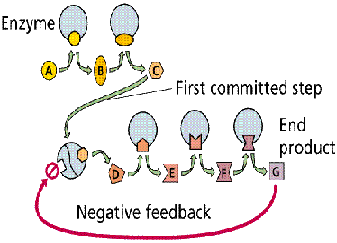
Enzyme can be turned on or off under different conditions.
Regulators combine to allosteric sites and enzyme activity is altered.
Left: If too much enzyme product is produced, then the product will act as an inhibitor and shut down enzyme activity.
|
ENZYMATIC ACTIVITY
Factors affecting enzymatic activity
1) Substrate and enzyme concentrations
Increase substrate, but not enzyme: rate of rxn will increase at first but when all enzymes are being used, the rate will level off
Increase enzyme, the rate of reaction will continually increase
2) pH (affects active site)
3) temperature (human enzymes function best between 35 - 40oC)
High temp. - denaturation (irreversible)
Low temp. - activation (i.e. reversible)
4) Inhibitors (bind to active/allosteric site)
COENZYMES & COFACTORS
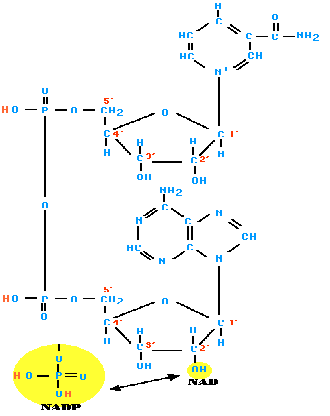
Many enzymes require the presence of small non-protein molecules for catalytic activity.
Cofactors
Metal ions locked into active sites of enzymes.
Draw electrons away from bonds of substrate molecules being broken.
e.g. Cu2+, Zn2+, Mg2+, K+, Fe2+, Na+
Coenzymes
- loosely bound to enzymes
- combines with enzymes when enzyme is acting on substrate
- organic, non-protein complex
- unchanged after reaction
- serve as electron acceptor
a) Coenzyme I or NAD+ (nicotinamide adenine dinucleotide)
b) Coenzyme II or NADP (nicotinamide adenine dinucleotide phosphate)
c) Coenzyme A
- not a nucleotide
- contains a non-cyclic molecule derived from vitamin B complex (pantothenic acid) which is united to the sugar by 2 further phosphate groups
- pantothenic acid derivative bears a terminal sulfhydral -S-H group
- important reactions take place at the S
- often written as CoA-S-H
Back to home page
Back to Biochemistry page