Basic Chemistry
Page Contents
Periodic Table

Back to page contents
Basic Chemistry Definitions
[A]
[B]
[C]
[D]
[E]
[F]
[G]
[H]
[I]
[J]
[K]
[L]
[M]
[N]
[O]
[P]
[Q]
[R]
[S]
[T]
[U]
[V]
[W]
[X]
[Y]
[Z]
Back to page contents
A
- Acid
- A substance that produces hydrogen ions in solution
- A proton donor
- pH < 7
- Anion
- Aqueous Solution
- A solution in which water is the solvent
- Atom
- A core (nucleus) of protons & neutrons surrounded by an orbiting cloud of electrons.
- Chemical behaviour is determined by distribution of electrons and number of valence electrons.
- Smallest part of an element.
- Atomic Number
- Number of protons in the nucleus of an atom.
- In an atom that is NOT an ion, the atomic number equals the number of electrons.
- Avogadro's Number
- 6.02 x 10²³ atoms/mole
- Number of atoms/molecule in a gram molecule
Back to alphabetical index
Back to page contents
B
- Base
- Any substance that combines with H+ ions (proton acceptor)
- Has a pH value above 7
Back to alphabetical index
Back to page contents
C
- Cation
- A positively charged ion.
- Chemical Energy
- The energy released by the formation of chemical bonds between atoms
- Chemical Bond
- Chemical Property
- Characteristics of a substance that can be determined through a chemical reaction.
- Chemical properties describe the behavious of a substance when reacted with other substances.
- Compound
- Pure substance when two or more substances or chemically combined.
- Concentration
- The strength of a solution expressed as the number of moles per litre of solution.
- C = x mol/L
- Ratio of litre of solute to litre of solution
- Covalent Bond
- A type of bonding in which the bonded atoms share a pair of electrons.
- Stable bond which holds molecules of the human body together.
- See polar covalent bond
Back to alphabetical index
Back to page contents
D
- Dynamic Equilibrium
- The point in a reversible reaction at which the rate of the forward reactions equals the rate of reverse reaction.
- The concentration no longer changes.
Back to alphabetical index
Back to page contents
E
- Electron
- Negatively charged particle found orbiting nucleus.
- Negligible mass (0.00055u)
- Electronegativity
- Ability of an atom in a molecule to attract shared electrons to itself.
- Increases from left to right and from bottom to top of periodic table.
- Element
- Any substance that cannot be broken down to any other substance by ordinary chemical means.
- Endothermic Reaction
- A chemical reaction in which the system absorbs heat from the surroundings.
- Exothermic Reaction
- A chemical reaction in which the system releases heat to the surroundings.
Back to alphabetical index
Back to page contents
F
Back to alphabetical index
Back to page contents
G
Back to alphabetical index
Back to page contents
H
- Hydrogen Bond
- A strong intermolecular interaction occuring when a H-atom is attracted to an O, N or F atom.
Back to alphabetical index
Back to page contents
I
- Ion
- An atom in which the number of electrons does not equal the number of protons
- Carries an electrical charge
- eg. Na ---> loses an electron ---> Na+
- Ionic Bond
- A type of bonding between two atoms when there is a transfer of bonding electrons to only one of the two bonding atoms.
- Usually occurs in a crystal, i.e. NaCl.
- Isomers
- Different compounds which have the same molecular formula but different structural formula.
- Isotopes
- Atoms of the same element that have the same number of protons but a different number of protons.
- Differ in atomic mass but have similar chemical properties.
- i.e. C-12, C-13 and C-14
Back to alphabetical index
Back to page contents
J
Back to alphabetical index
Back to page contents
K
- Kinetic Energy
- The energy of motion.
- E = mv2/2
Back to alphabetical index
Back to page contents
L
Back to alphabetical index
Back to page contents
M
- Molar Mass
- The mass of one mole of an element/compount
- Unit: g/mol
- Used to convert from moles to mass.
- Molar Volume
- Volume of one mole
- 22.4 L under STP conditions
- Mole
- A standard unit for measuring the amount of a substance.
- 1 mole = 6.02 x 10²³ atoms/molecule
- Molecular Formula
- The composition of an element.
- Molecule
- A group of atoms held together by energy.
Back to alphabetical index
Back to page contents
N
- Neutron
- Neutral charge found in nucleus of atom.
- Mass of 1.00867u
Back to alphabetical index
Back to page contents
O
- Oxidation
- Any reaction in which electrons are lost.
Back to alphabetical index
Back to page contents
P
- Physical Property
- Property determined without altering chemical composition of the substance.
- Polar Covalent Bond
- A covalent bond formed between atoms with different electronegativities
- Slight separation of charge
- Note: a substance can have polar bonds but be a non-polar molecule, i.e. H20
- Potential Energy
- The energy possessed by a body because of its relative position in space.
- The farther away an electron is from the nucleus, the more energy it possesses.
- Proton
- Positive charge found in nucleus of atom
- Mass of 1.00728u
- Pure Substance
- A substance that cannot be broken/separated by physical means.
Back to alphabetical index
Back to page contents
Q
Back to alphabetical index
Back to page contents
R
- Reduction
- Any reaction that involves a gain of electrons.
Back to alphabetical index
Back to page contents
S
- Solute
- A substance (solid/liquid/gas) that dissolves in a solvent to produce a solution.
- Solution
- A mixture of uniform composition, prepared by dissolving a solute in a solvent.
- Solvent
- The substance in which a solute is dissolved to produce a solution
- Usually a liquid (water is known as the universal solvent)
Back to alphabetical index
Back to page contents
T
Back to alphabetical index
Back to page contents
U
Back to alphabetical index
Back to page contents
V
- Valence electron
- An electron that is contained in the outermost energy level of an atom
- Determines bonding & chemical behavious of an atom
Back to alphabetical index
Back to page contents
W
Back to alphabetical index
Back to page contents
X
Back to alphabetical index
Back to page contents
Y
Back to alphabetical index
Back to page contents
Z
Back to alphabetical index
Back to page contents
Chemical Bonds
Covalent Bonding: Atoms are held together by sharing electrons.

Ionic Bonding: One or more electrons are transferred from one atom to another.
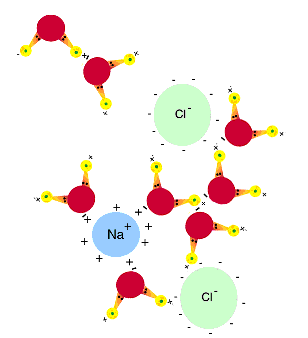
Hydrogen Bonding: Form between hydrogen and oxygen. Weak bonds that are easily broken and reformed.

Back to page contents
Importance of Water
Water is a molecule fundamental to all life. Because of its lattice structure, which allows the formation of many hydrogen bonds with surrounding water molecules, water is an ideal medium for the suspension of the molecules and reactions of life and a virtually universal solvent. When salts, acids and bases are placed in water, they dissociate and become ions. Ions are chemical particles that carry a charge.
 Properties of Water
High polarity
High specific heat
High heat of vaporization
Low density of ice
Cohesion
Back to page contents
Functional Groups
Functional groups are the chemical building blocks of life. They determine chemical properties of molecules. During chemical reactions functional groups are transferred from one substance to another.
Principal functional groups
 1) Hydroxyl group
 2) Carbonyl group -C=0
 3) Carboxyl group -C=0-OH
 4) Amino group -NH2
 5) Phosphate group
Linkages

Ether linkages are formed from the dehydration of two alcohols.

Ester linkages are formed from the dehydration of an acid and an alcohol.

Anhydride linkages are formed from the dehydration of two acids.

Peptide bonds are formed from the dehydration of two amino acids.
Back to page contents
Polymerization Reactions
Dehydration reaction
A hydroxyl group (OH) is removed from one subunit and a H is removed from the other.
Cells supply energy required to break covalent bonds to form polymers.
Hydrolysis reaction
A hydrogen atom is attached to one subunit and a OH to the other.
Back to page contents
Back to home page
Back to Biochemistry page