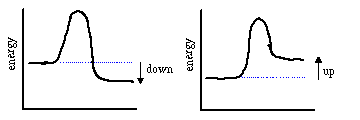
All chemical reactions tend to proceed spontaneously toward a state of maximum disorder and minimum energy. Reactions in which the products contain less energy than the reactants must release the excess "free energy". These reactions are spontaneous and termed exergonic (diagram on the left). When products contain more energy than the reactants then there must be an input of energy from an outside source. These reactions are not spontaneous and are termed endergonic (diagram on the right). Before it is possible to form new chemical bonds with less energy, it is necessary to break the existing bonds, and that requires extra energy called activation energy to destabilize existing chemical bonds and initiate a chemical reaction.